Showing posts with label Google_books. Show all posts

Tuesday, 22 March 2011

Court rejects Google Books settlement

Significant setback in Google's path to world domination. CNET News reports that

Adding another chapter to a long, drawn-out legal saga, a New York federal district court has rejected the controversial settlement in a class-action suit brought against Google Books by the Authors Guild, a publishing industry trade group.


"While the digitization of books and the creation of a universal digital library would benefit many, the ASA would simply go too far," a court document explains. "It would permit this class action--which was brought against defendant Google Inc. to challenge its scanning of books and display of 'snippets' for on-line searching--to implement a forward-looking business arrangement that would grant Google significant rights to exploit entire books, without permission of the copyright owners. Indeed, the ASA (Amended Settle Agreement) would give Google a significant advantage over competitors, rewarding it for engaging in wholesale copying of copyrighted works without permission, while releasing claims well beyond those presented in the case."


The settlement would grant Google the right to display excerpts of out-of-print books, even if they are not in the public domain or authorized by publishers to appear in Google Books. When the settlement was initially announced in mid-2009, opposition flooded in from lawyers on behalf of Microsoft, the Electronic Frontier Foundation, and a coalition called the Open Book Alliance who decried it as anticompetitive.


"Google and the plaintiff publishers secretly negotiated for 29 months to produce a horizontal price fixing combination, effected and reinforced by a digital book distribution monopoly," a lawyer for the Open Book Alliance said at the time. "Their guile has cleared much of the field in digital book distribution, shielding Google from meaningful competition."

Monday, 5 October 2009

Complementing the OPAC With a Full Text Search Book Catalogue

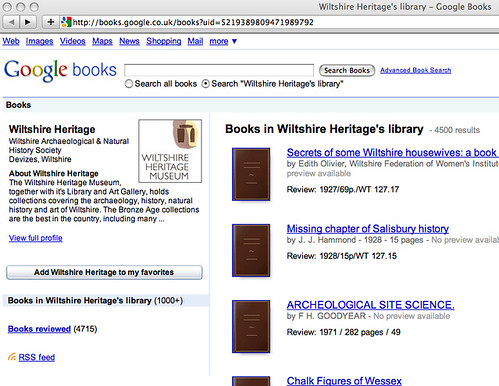
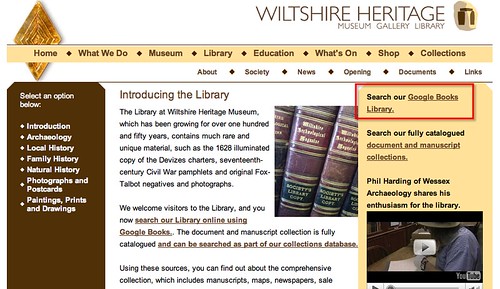
In part by way of a follow up to the Engaging With the Issues Raised By The Google Book Settlement , here's a very recent example of a Library that has engaged with Google Booksearch to produce a custom full text booksearch engine built around some of their holdings: 150 year old Wiltshire library goes digital - thanks to Google

The Wiltshire Heritage Museum library has just gone online with a full digital library created in just 5 months using the controversial Google Books service.


Wiltshire Heritage Library does Google books.... http://www.wiltshireheritage.org.uk/library/

How so? By using the Google Books personal library facility: My Library, which allows you to create a custom search engine limited to searching over the full text of the books you have added to your Google book library.

At the moment there's not a lot of branding on the Wiltshire Heritage page, and the URL is a vanilla rather than redirected one (or even a vanity URL), but the functionality is there...

Wiltshite Heritage library on Google books http://books.google.co.uk/books?uid=5219389809471989792

That said, there is a Google Books API to code against for developing custom services based around this collection. The default RSS feed provides a feed of the books added most recently to the Google books collection.

There is also potential for embedding the search facility within the Wiltshire Heritage Library domain using Google's Co-Branded Search facility.

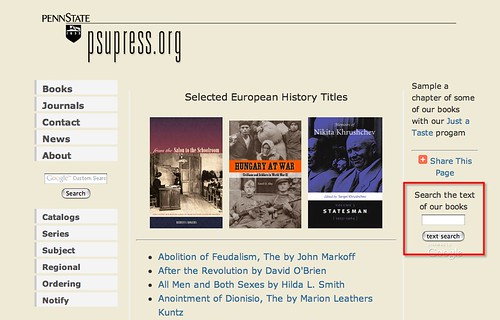
Here's an example of such a cobranded experience, from Penn State University. First, the search box:

Penn State Google booksarch http://www.psupress.org/books/book_subject_eurohist.html

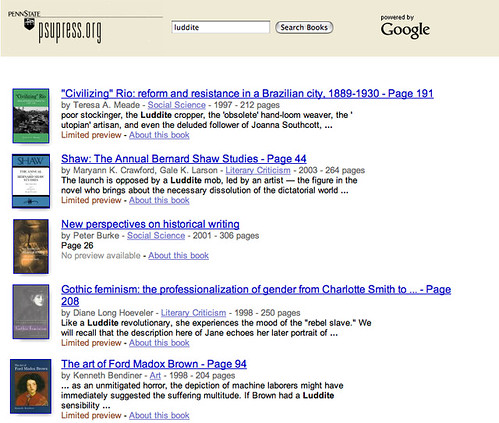
The results page can be branded along the top:

Searching Penn State with Google books http://www.psupress.org/books/book_subject_eurohist.html

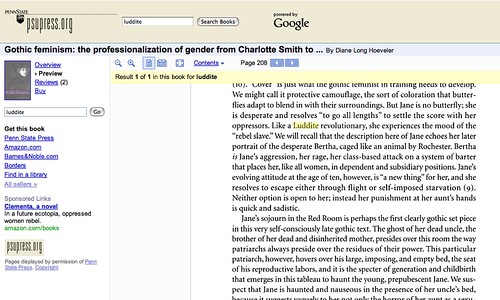
For books with a limited or full preview, the preview page can be similarly branded:

Penn State -= google books preview

In the context of the Cambridge Libraries, I'd have thought that the sheer number of affiliated libraries means that there is at least the potential for running a small trial of this service over some of the holdings from one of the departmental or College libraries? Or maybe not...

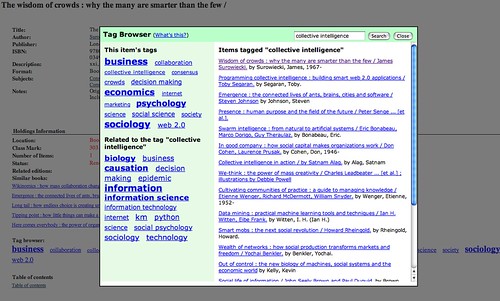
Although not a full text search service, LibraryThing's LibraryThing for Libraries service can complement a legacy OPAC with book recommendations and tag based pivot searching around a particular book using the wisdom of the LibraryThing userbase.

LibraryThing for Libraries is currently being trialled by the OU Library with their Voyager OPAC, as this example of tag based browsing around a particular book result shows:

LibraryThing for Libraries at the OU

See also this list of examples of LibraryThing for Libraries in action.

Thursday, 1 October 2009

Engaging With the Issues Raised By The Google Book Settlement

Like it or not, Google Book Search and the Google Book settlement are going to bring full text search to the world of published books... Web based search tools that let you search through books are not not going to happen.

Yes there may be problems with the meta-data (e.g. Google Books, The Metadata Mess) but there are use cases and there are use cases.


(I'd have thought Google was scanning the books in toto, though, which means they should also be scanning the bibliographic data..? (And which in turn means there should be a short term, stop gap fix for getting round elements of the data mess by using a few well crafted search query patterns?))

Just because Google Book Search may not (currently) be appropriate for certain forms of research doesn't mean that it's not useful in other ways, and doesn't mean that spi-off technologies, such as the ability to embed a preview of a book in a third party webpage, find books related by similarity of content (if not classification), or share reviews aren't useful... (Bear in mind too that most of those services can also be accessed via an API.)

Although the Google Book Settlement has been taken back under advisement, it's still worth considering some of the issues raised, and maybe even getting involved in the debate.

EduServ's Andy Powell has produced a quick guide to the settlement (The Google Book Settlement) which provides a great summary if you need bringing up to speed...


Andy also refers in his supporting blogpost to a set of consultation questions posted by JISC surrounding the summer 2009 version of the settlement that have been published on WriteToReply: JISC seeks your views on the US Google Book Settlement

For example, the questions they're asking include:

View comments on this question

View comments on this question

View comments on this question

It's well worth contributing to that debate becuase it's an issue that is not going away...

(Note that the above questions have been embedded on this page from the original consultation document using an embed code similar to that used to embed the slideshare presentations.)

Disclaimer: I am a director of Public Platforms Ltd, the publisher of the WriteToReply consultation platform.

Thursday, 18 June 2009

Google Books 2.0

Lots of new features (many of them involving embedding). Good summary here.

Tuesday, 26 May 2009

Anatomy of the Google book deal

Publisher's Weekly has a rather good summary of the state of play with the Google Book Deal, following the judge's decision to allow another four months'-worth of consideration before the deal is ratified.

Thursday, 22 January 2009

Why you can't find a library book in your search engine

This is an interesting article in the Guardian about searching for books online and finding your nearest library that has the one you want. I was surprised to read that OCLC are quite resistant to this idea. Their WorldCat is a great tool, but not everyone knows it's there, so why not make it possible for search engines to access WorldCat and make sure it's well badged in search results?

Despite the internet's origins as an academic network, when it comes to finding a book, e-commerce rules. Put any book title into your favourite search engine, and the hits will be dominated by commercial sites run by retailers, publishers, even authors. But even with your postcode, you won't find the nearest library where you can borrow that book. (The exception is Google Books, and even that is limited.)

That's strange, because almost every library has an electronic database of its books - searchable either at the library's own website or via its local council. The wrinkle is that at the book level, those databases aren't accessible to the search engines; and you may not be able to search all the libraries in your area at once.

Yet there is an alternative that few people seem aware of: Worldcat (worldcat.org), which offers web access to the largest repository of bibliographic data in the world - from the 40-year-old Ohio-based non-profit Online Computer Library Center (oclc.org). But Worldcat suffers from the same problem on a larger scale. OCLC shares only 3m of its 125m records with Google Books; none of them show up in an ordinary search.

Apparently OCLC are considering making WorldCat records easier to search, though, according to this post: OCLC, Record Usage, Copyright, Contracts and the Law

Thursday, 10 July 2008

Critical article on Google Books project

ABSTRACT

The Google Books Project has drawn a great deal of attention, offering the prospect of the library of the future and rendering many other library and digitizing projects apparently superfluous. To grasp the value of Google’s endeavor, we need among other things, to assess its quality. On such a vast and undocumented project, the task is challenging. In this essay, I attempt an initial assessment in two steps. First, I argue that most quality assurance on the Web is provided either through innovation or through “inheritance.” In the later case, Web sites rely heavily on institutional authority and quality assurance techniques that antedate the Web, assuming that they will carry across unproblematically into the digital world. I suggest that quality assurance in the Google’s Book Search and Google Books Library Project primarily comes through inheritance, drawing on the reputation of the libraries, and before them publishers involved. Then I chose one book to sample the Google’s Project, Lawrence Sterne’s Tristram Shandy. This book proved a difficult challenge for Project Gutenberg, but more surprisingly, it evidently challenged Google’s approach, suggesting that quality is not automatically inherited. In conclusion, I suggest that a strain of romanticism may limit Google’s ability to deal with that very awkward object, the book.


Link